Summer of 2024 had some memorable moments – some good, some bad, some terrifying.
Our goal during this cruise was to reach the Haida Gwaii, the islands about 60 miles off the North BC coast. There are two main islands, with the southern main island being where the Gwaii Hanaas park is located. Visiting the park requires a permit, a schedule and a visitor orientation session in Skidegate prior to park entry. And crossing Hecate strait, which puts fear into many a boater. Why do you think they named it after a witch?
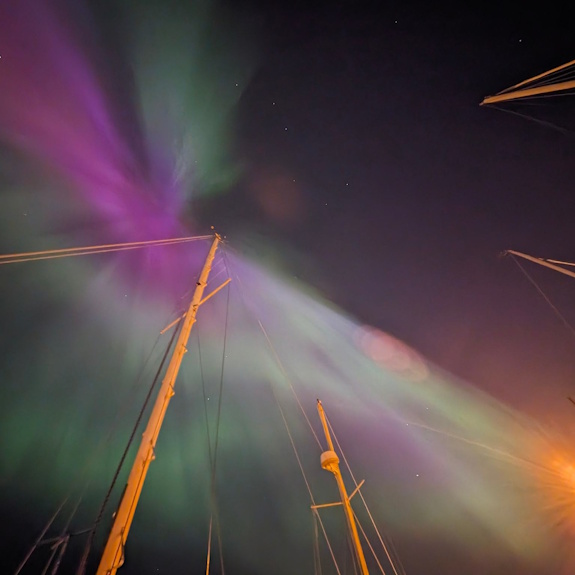
But let me start at the beginning of our cruise. Before we left Bellingham in early May, we saw the northern lights on an impressive show.
One exciting memorable event was docking in Comox with a 20 knot following wind pushing us in to the marina fairway. When we discovered the assigned slip to port was not going to be feasible, we had to do a wind-defying spin of our 38 ft boat in about a 50 ft wide fairway to reach a port side tie on the other side of the fairway. The ole Perkins and gearbox dealt with it well, as helmsman Marilyn gunned the engine alternating between forward and reverse to get Rainshadow to essentially spin on her keel without getting swept away by the wind while cross-ways to it. Deckhand Van watched with fenders ready to protect us if needed, but it all happened so fast he didn’t have time to do anything except watch. All’s well that ends well – we didn’t hit any other boats and Rainshadow ended up nicely docked. Definitely one of those – don’t think, just do it – moments, else we would have been pinned to the end of the fairway seconds later. Still makes my heart rate increase more now when I think about it now, than it did while I was taking action. No time for pictures during that fast action.
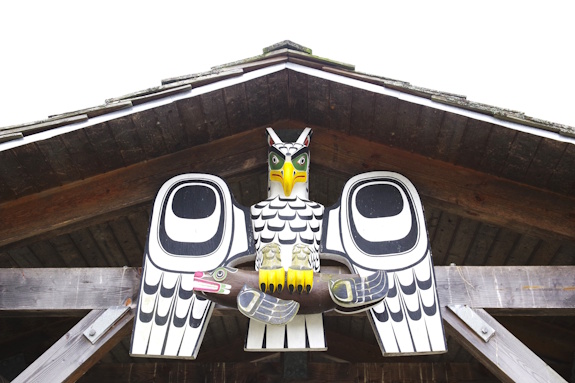
We stopped at Alert Bay this year for the first time – and it definitely will not be our last. We had a very nice walk in a forest, listening to the Ravens. We also enjoyed visiting the Cultural Center, and viewing all the wonderful artwork along the boardwalk.
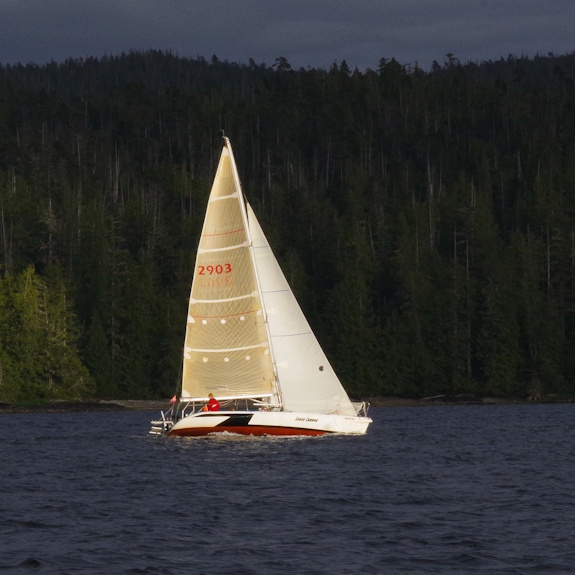
A good memorable event was seeing several of the R2AK racers going past once we rounded Cape Caution. We were in Pruth Bay, where there is one of the rare internet connections. We learned that the lead boat was due to pass nearby in a few hours. We made a split decision, after already underway towards Queens Sound. Let’s return to Fitz Hugh Sound so we could watch the leader pass! After that, we acted like R2AK groupies for a while, taking a route so we could see more teams pass and even meet some of the support staff and crews while at Shearwater. We gave one pedaling crew in a windless section a water jug refill – they confirmed it was allowed for us to assist them on their 750 NM non-motorized race from Port Townsend to Ketchikan. I admire the R2AK racers for believing they don’t need a motor on this adventuresome journey.
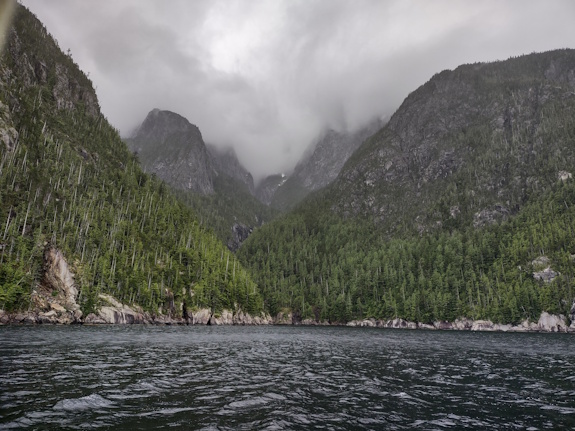
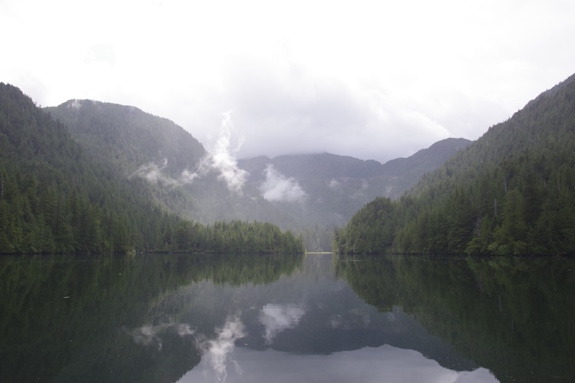
A beautiful memory is our trip through Dean and Burke Channels. These create a loop that goes some distance inland. Land heating creates some nice inflow winds, which mean fun downwind sailing on the way inland, and tough tacking on the way out. The scenery was spectacular in places.
We also had a first-ever trip down Grenville Channel. This is a 45 NM long arrow-strait channel on the Inside Passage route. Every other year we’ve been cruising on the BC north coast, we have avoided traveling this way. This year we decided we would. We meet some friendly brave people taking a Hobie Cat from WA to AK. We helped them with a repair. For us, while underway, it was educational about how strong the winds can be in that long funnel. It was also beautiful and calm in one anchorage.
A very bad memorable event was when we were docked against the breakwater in Prince Rupert. Usually while docked, we step down from our boat deck to the dock. But in this situation, we stepped up from the deck to the dock because of the height of the breakwater pier. In other words, it was designed for much larger boats than ours. When a small zippy fishing boat (aka a “sporty”) came towards the marina on a plane, then came “off step” inside the breakwater, he created a huge wave as his boat stopped planning and displaced water for his hull. That massive wave tossed all the boats about in the marina. One person who sleeping in their bunk was tossed out. Others had things crash and break. Rainshadow got rolled so violently that the starboard rail got caught beneath the breakwater boards. Not just once, but 3 times or maybe more – it was too dramatic to think. Rainshadow would be stuck under the dock boards for a few seconds as the wave height reduced, then the force of the boat pushing up on the dock boards caused things to break. Rainshadow won the battle, in that the dock was missing a 2”x12”x20’ board when it was all over. Huge nails stuck out from the board as it floated away. But Rainshadow’s teak toerail was splintered for about a 5’ length. Fortunately, the glassed deck-hull joint seemed to survive. If the dock had not failed, Rainshadow could have been swamped by the following wave. It was a very serious situation. Other lesser built boats may have had a splintered topside or deck. I guess we took no photos of that damage. It’s not a good memory.
Despite all the witnesses, the sporty captain denied all wrong doing. Prince Rupert authorities could do nothing because they did not observe it. We couldn’t leave Rainshadow with a splintered toerail – lines would catch on the jagged edges. So we spent a couple more days in Prince Rupert cutting out the damaged teak and replacing it with the best wood we could find in town – some red oak. Another day, we’ll replace that red oak with proper teak.
Staying in Prince Rupert those extra days meant that we again met up with an adventuresome couple who were sailing their small hobbie cat from Seattle to Juneau. I mentioned we had helped them repair their failed pedal mechanism in an anchorage off Grenville channel – using a piece of plastic cutting board to fashion a new bearing for their pedal drive. We were happy to see they made it out of Grenville Channel. It had turned to a wind tunnel for a few days and we knew they would get pinned down. But fortunately, they made it to Prince Rupert before they ran out of food and water. They, in turn, introduced us to a couple that was rowing in rowing shells from Comox to Skagway. Wow. And we thought we were adventuresome. We had a lovely time meeting with these younger enthusiastic folks and enjoying their energy.
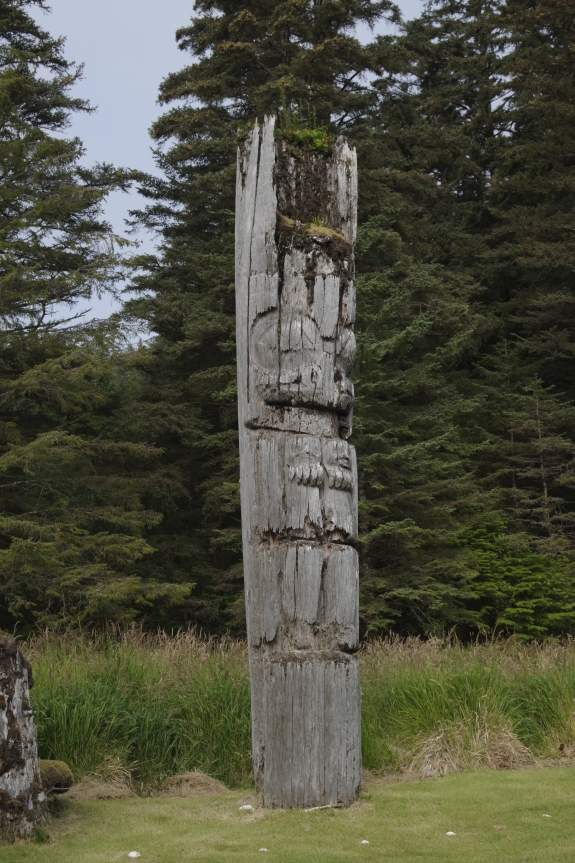
Finally we were in position and the right weather window opened so we could sail across Hecate strait for Skidegate in Haida Gwaii. The first 8 hours was a lovely sail, the last 8 hours was a long motor. We anchored around 4AM, exhausted. After enjoying several days in that area, including the visit to the Haida center for the required (and informative) orientation, we were finally ready to journey to the Gwaii Haanas park. Another long motor got us into the park, where we had a wonderful time exploring its nooks and bays for about 2 weeks. Our final stop was on the southwest end of the island group, where there is a designated UNESCO World Heritage site at the best preserved ancient Haida village. Being in the park was all good memorable moments.
Then came the terrifying memory – or I should say the exhausting 2 hour ordeal we endured because we made a poor choice. As we were departing our last stop in the Haida Gwaii, there was a great NW wind flowing along the island chain. We made a last minute decision to go south of Cape St James at the southern tip of the island, to enjoy that following wind. We had planned to head east through a windless channel to cut from the west side to the east side of the island group. We know better to be more cautious in planning, but we were seduced by the thought of sailing on a great wind all the way to Vancouver Island – 100+ NM away.
A cape is a dangerous place because the land separates two large bodies of water. In this case, Cape St. James is where Hecate Strait meets the open water of the North Pacific Ocean. It was an ebb tide, which meant massive amounts of water were flowing out of Hecate Strait into the open water. At one point, we experienced 4 knots of current pushing us sideways, while a 20-25 knot breeze pushed us forward at about 6-7 knots. That meant we were crabbing our way forward, the bow not pointing the direction of travel. The wind vs current also created large waves, and there were tide rip areas. Steering to keep the downwind sails full, yet not round-up as the waves tossed us about, was physically and mentally demanding. Marilyn steered, studying the current-induced steep waves forward, while Van warned her of the larger wind waves approaching from the stern. All the while during this 10 NM area of turbulence, we knew the conditions would worsen if we crabbed too far south to where the chart showed severe tide rips created by some seamounts. This was a big area – 10 NM from the Cape to the dangerous area around the seamounts – but it also was about 10 NM to come into the lee of the island chain. In the end, we simply sailed out the wind. The waves continued, but the wind was blocked as we reached Hecate Strait and the wind protection afforded by the Haida island group.
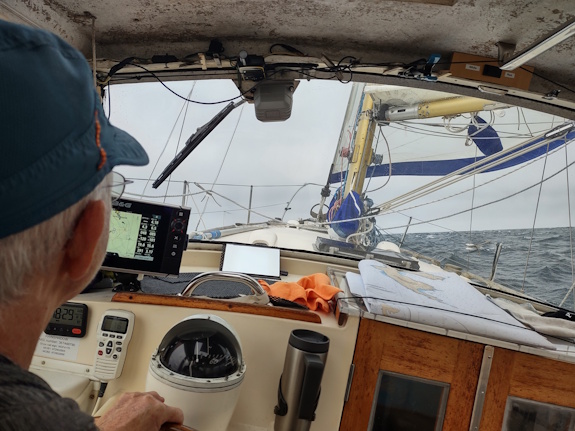
It was during the ensuing 18 hours of motoring, that for the first time in my sailboat ownership, I actually recognized the engine as a useful tool in a sailor’s toolkit. We carry a full set of sails so we can sail in light winds to storm winds. We are always focused on how to sail more – I even wrote a book about it. But that night, when I was exhausted, the sea state was horrible and there was not enough wind to sail – I was happy the motor was moving us forward to where we could finally drop anchor and rest. I was actually comforted by the roar of the motor. It was not the beast in the bilge; it was the tool that meant we would make landfall sooner without getting beat up further in the windless rough Hecate Strait.
Our journey back to Bellingham was fine in my memory. Van had a much different experience I guess. We had a nice visit with friends during random encounters along the way. We safely hauled out in Bellingham to leave Rainshadow in the boatyard for what turned out to be much longer than we expected. But that’s a different story.